Introduction
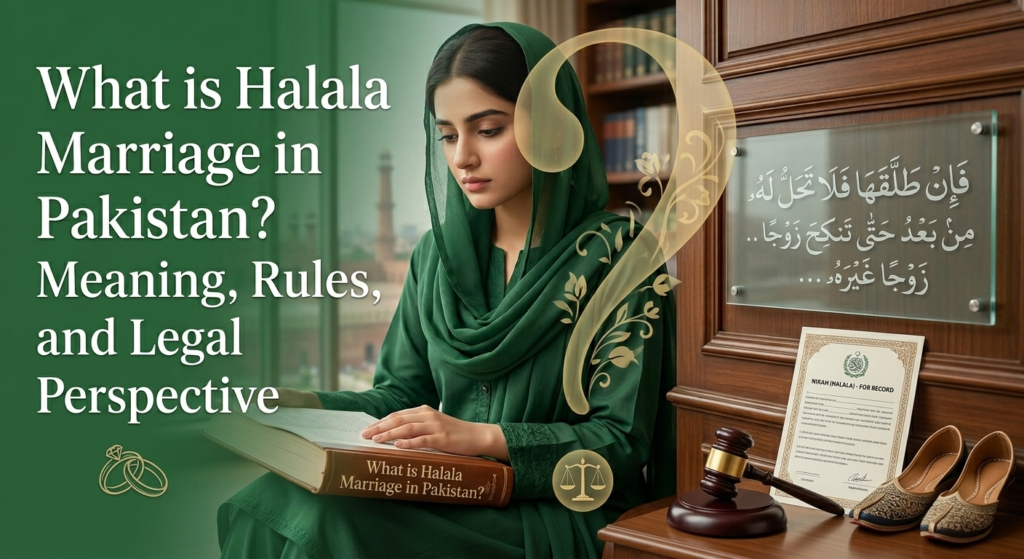
Halala marriage in Pakistan is one of the most sensitive and widely misunderstood topics within family law. People often discuss it in cultural and emotional contexts, which creates confusion and spreads misinformation.
At Lawyer Services Pakistan, the aim is to provide accurate, clear, and legally grounded information so individuals can better understand their rights and responsibilities. This article explains the meaning of Halala marriage, its religious background, applicable rules, and its legal position in Pakistan.
What is Halala Marriage? (Meaning & Basic Concept)
Halala marriage, commonly referred to as Nikah Halala, arises in a specific situation following a triple divorce (talaq).
In simple terms:
- If a husband divorces his wife three times, the marriage becomes permanently dissolved
- The couple cannot remarry unless:
- The woman marries another man
- That marriage is genuine
- And it ends naturally through divorce or death
It is important to understand that Halala is not a planned practice but a conditional outcome within Islamic marital principles.
A key distinction must be made:
- Halala is not a service or arrangement
- It is a religious condition that occurs only under specific circumstances
Background: Divorce and Remarriage in Islam
To understand Halala, it is essential to examine how divorce operates under Islamic principles, which also influence family law in Pakistan.
Types of Divorce (Talaq)
- First and second talaq are revocable
- Third talaq is final and irreversible
Iddat (Waiting Period)
After divorce, a woman must observe a waiting period known as iddat before remarrying.
Remarriage Rules
- Couples may remarry after the first or second divorce without restriction
- Halala becomes relevant only after the third divorce
This framework aims to prevent the misuse of divorce and preserve the seriousness of marital commitments.
Rules and Conditions of Halala in Islam
Islamic teachings establish strict conditions for a valid Halala situation:
- The second marriage must be genuine and entered voluntarily
- It must not be pre-arranged or planned
- The marriage must be consummated
- The second husband must end the marriage naturally, without pressure or agreement
Pre-planning or commercializing Halala contradicts Islamic principles, and Islamic scholars widely consider it impermissible.
Scholarly Perspective
Islamic scholars generally agree that:
- Arranged Halala is prohibited
- Intention plays a decisive role in determining validity
Misconceptions and Misuse of Halala
There are several widespread misconceptions regarding Halala marriage:
1. Myth: Halala is required after every divorce
Reality: It applies only after a third, irrevocable divorce
2. Myth: Halala can be arranged or paid for
Reality: Such practices are forbidden and unethical
3. Myth: Halala is part of Pakistani law
Reality: It has no formal legal recognition
The misuse of Halala, particularly through arranged or commercial practices, raises serious ethical concerns and conflicts with established family law principles.
Legal Perspective of Halala in Pakistan
From a legal standpoint, Pakistan does not recognize Halala as a formal institution.
No Legal Status
Pakistani law does not regulate or endorse Halala as a legal requirement.
Muslim Family Laws Ordinance, 1961
Under this law:
- Remarriage between divorced spouses is permitted unless it was a third divorce
- There is no defined legal procedure for Halala
Role of Courts
Courts dealing with family law matters focus on:
- Validity of divorce
- Reconciliation procedures
- Protection of individual rights
Legal Implications of Misuse
- Forced or paid Halala arrangements may result in legal consequences
- Such practices may be challenged under broader legal protections
Religious Scholarly Views and Debates
Scholars across different schools of thought emphasize one central principle: intention.
If a marriage is entered solely to make Halala possible, it is considered invalid or sinful. However, if a genuine marriage takes place and ends naturally, it may fulfill the required condition.
Many scholars strongly criticize the modern misuse, especially when people treat Halala as a transactional or arranged process.
Women’s Rights and Ethical Considerations
People often discuss Halala in relation to women’s rights, especially within the framework of family law in Pakistan.
Key concerns include:
- Lack of informed consent
- Risk of coercion
- Emotional and psychological impact
Ethical discussions emphasize the importance of:
- Protecting dignity
- Ensuring voluntary participation
- Preventing exploitation
There is increasing awareness around safeguarding women from misuse of religious concepts in both legal and social contexts.
Conclusion
Halala marriage in Pakistan is a misunderstood concept that stems from Islamic teachings, but people often misapply it in practice. It is neither a structured legal process nor a recognized requirement under Pakistani law.
At Lawyer Services Pakistan, the focus is on providing clear and reliable guidance on family law matters so individuals can make informed decisions. Understanding the distinction between religious principles and their misuse is essential for protecting rights and maintaining ethical standards.
For accurate guidance, individuals should consult qualified legal professionals and knowledgeable scholars rather than relying on informal or misleading sources.
Frequently Asked Questions
Is Halala compulsory after divorce in Pakistan?
No. It is only relevant after a third irrevocable divorce, not in all cases.
Is arranged Halala allowed in Islam?
No. Pre-planned Halala is considered forbidden.
What does Pakistani law say about Halala?
Pakistani law does not recognize Halala as a legal requirement.
Can a couple remarry without Halala?
Yes, if the divorce was not final (less than three talaqs).
Are Halala services legal in Pakistan?
No. Such services are widely considered unlawful and exploitative.
This article is general information about the law in Pakistan, not legal advice for your situation.