
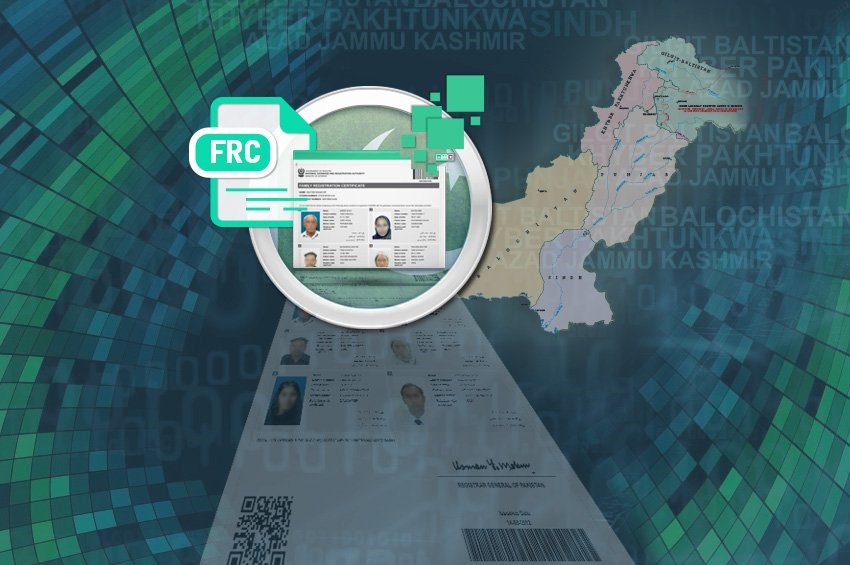
FRC stands for Family Registration Certificate. It is a document issued by NADRA (the National Database and Registration Authority) that shows your official family tree — parents, spouse, children, and siblings — exactly as it is recorded in NADRA’s database. Pakistanis use it most often for visa applications, embassy verification, inheritance cases, and sponsoring family immigration.
If you already applied for an FRC and want to check its status or verify it online using your CNIC, see the “How to Check FRC Online by CNIC” section below. If you’re applying for the first time, keep reading from the top.
Quick Answer Box
| Question | Answer |
|---|---|
| FRC full form | Family Registration Certificate |
| Issued by | NADRA (National Database and Registration Authority) |
| What it shows | Your registered family tree — parents, spouse, children, siblings |
| Standard fee | Approx. PKR 1,000 (normal processing) |
| Processing time | 2–4 working days online; same day at a NADRA center |
| Check/apply online | Pak-Identity portal (id.nadra.gov.pk) or the Pak-ID mobile app |
What Is FRC? (Full Form, Meaning & Stands For)
FRC is the short form of Family Registration Certificate, sometimes written as “FRC NADRA” since NADRA is the only authority that issues it. The document includes:
- Full names of family members
- CNIC / NICOP / CRC numbers of each person
- Relationship structure (parent, spouse, child)
- Each member’s registration status in NADRA’s system
Unlike a Character Certificate, which confirms an individual’s conduct record, or a CNIC, which identifies one person, the FRC gives a complete family overview in a single document — which is why embassies, courts, and financial institutions accept it as proof of family relationships.
Why Is FRC Important?
Authorities ask for an FRC when they need documentary proof of a family relationship — for example, in family law matters, to confirm that a sponsor and an applicant are really parent and child, or husband and wife, before approving a visa or an inheritance claim.
2026 Update: FRC Is Now a Legal Document
In mid-2026, NADRA formally declared the FRC a legal document for the first time, placing it in the same category as the CNIC and the Child Registration Certificate (B-Form). NADRA also introduced a combined certificate that shows both a person’s birth family and married family on one document, and expanded self-service checking so biometric verification can confirm registered family details without a center visit in many cases. If an FRC check ever returns an error you believe is wrong, NADRA’s complaint portal and helpline (1777) are the official channels to raise it.
How to Check FRC Online by CNIC
If you’ve already submitted an FRC application, or you simply want to confirm what NADRA has on record for your family, you don’t need to visit a NADRA office. Here’s how to check your FRC online using your CNIC.
Method 1: Check FRC Status via the Pak-Identity Portal
NADRA’s official online system for identity documents — including the FRC — is the Pak-Identity portal. It handles both new FRC applications and verification of an FRC you already applied for.
- Go to the Pak-Identity website (id.nadra.gov.pk) on your browser.
- Log in to your account, or register if this is your first time (you’ll need your CNIC/NICOP number; an SMS and email verification code are sent during signup — applicants outside Pakistan receive the code by email only).
- Open “Track Application” / “Application Status” and enter your tracking ID (sent to you when you first applied) or your CNIC number.
- The portal shows your FRC’s current status: under process, ready, or dispatched.
- Once marked ready, download the FRC as a PDF directly from the portal.
Method 2: Check FRC via the Pak-ID Mobile App
NADRA also offers the Pak-ID app, the mobile version of the Pak-Identity portal. Enter your CNIC number in the app, select the Family Registration Certificate / “Verify My Family” option, and the app pulls your registered family tree the same way the web portal does. This is the most convenient option for overseas Pakistanis checking their FRC from abroad.
Method 3: Verify an Existing FRC’s Authenticity
If you already hold a printed or downloaded FRC and need to confirm it’s genuine — for example, before submitting it to an embassy — the Pak-Identity portal’s verification option lets you check a specific FRC’s details against NADRA’s live database using the CNIC and the FRC’s reference number.
Can I Check FRC by CNIC Without an Account?
No. NADRA’s online systems require a registered Pak-Identity account tied to your CNIC before they will show family data — this protects the privacy of everyone listed on the certificate. If you don’t want to create an account, your alternative is visiting a NADRA Registration Center in person with your original CNIC, where staff can check and reissue your FRC on the spot.
Why You Might See “No Record Found”
This almost always means one of your family members isn’t yet linked in NADRA’s system — not that the check failed. See “Common Issues and How to Resolve Them” further down this guide.
Who Needs an FRC in Pakistan?
The need for an FRC has grown significantly in recent years. You’re likely to need one if you are:
- Applying for a visa (UK, Canada, Australia, Gulf countries)
- Sponsoring a family member’s immigration
- Submitting documents to a foreign embassy
- Handling an inheritance or legal claim
- Verifying your family structure for an official process
Real-life example: students applying for study visas are frequently asked for a family registration document from Pakistan to confirm their parents’ identity and that the sponsorship is legitimate.
Types of FRC Issued by NADRA
NADRA issues different FRC types depending on your family structure.
1. FRC by Birth (Family Tree Certificate)
Shows parents and siblings. Used mainly by unmarried individuals to verify biological lineage.
2. FRC by Marriage (Spouse & Children Record)
Includes spouse and children. Used by married individuals for visa and legal documentation.
3. FRC by Adoption (Guardian Record)
Includes adoptive parents or legal guardians. Requires official adoption or legal guardianship proof.
Eligibility Criteria for FRC in Pakistan
Before applying or checking, make sure:
- You hold a valid CNIC, NICOP, or CRC
- All family members are registered with NADRA
- Each person has a unique identification number
- Family relationships are already linked in NADRA’s system
For overseas Pakistanis: you can apply and check your FRC using your NICOP through NADRA’s online system without visiting Pakistan.
Documents Required for Family Registration Certificate
Basic Documents
- CNIC or NICOP of the applicant
- CNICs or B-Forms (CRC) of family members
- Valid identification numbers for all members
Additional Documents (if applicable)
- Marriage certificate (Nikah Nama)
- Divorce certificate (if relevant)
- Adoption/legal guardianship documents
Quick Checklist
- ✔ All family members registered with NADRA
- ✔ CNIC/NICOP copies available
- ✔ Marital status updated in NADRA’s records
- ✔ Names and spellings verified against CNIC
How to Apply for a New FRC in Pakistan
If your FRC check shows no record, or you need one for the first time, there are two ways to apply.
Method 1: Apply Online via Pak-Identity
- Create a Pak-Identity account
- Select “Family Registration Certificate”
- Enter the required details
- Upload your documents
- Pay the fee online (debit/credit card, Easypaisa, JazzCash, or e-Sahulat)
- Track and download your FRC once processed
Best for: overseas Pakistanis and anyone who wants to avoid visiting an office.
Method 2: Apply at a NADRA Registration Center
- Take your original CNIC/NICOP and supporting documents
- Complete biometric verification
- Submit your application
- Collect your certificate once processed
Best for: urgent cases, or applicants facing technical issues online.
FRC Fee & Processing Time in 2026
- Standard fee: approx. PKR 1,000
- Executive/urgent service: slightly higher
- Online vs. in-person: fees are broadly similar; overseas applicants are charged the converted foreign-currency equivalent
- Processing time: 2–4 working days for online applications; same day or within a few days at a NADRA center
- Delivery: downloadable PDF (most common) or a printed certificate on request
Delays almost always trace back to incomplete or mismatched family records, not the payment or portal itself.
FRC vs. Other NADRA Documents
| Document | Purpose |
|---|---|
| FRC | Complete family structure (parents, spouse, children) |
| CRC (B-Form) | Registers a child under 18 |
| NICOP | National ID for overseas Pakistanis |
| Marriage Certificate | Proof of marriage (Nikah Nama) |
| Succession Certificate | Legal proof of inheritance rights, issued by a court |
The FRC is unique because it’s the only document that consolidates an entire family’s data into one certificate, rather than identifying a single person or a single event.
Common Issues and How to Resolve Them
1. Missing Family Member
Cause: Not registered with NADRA, or not linked to the family tree.
Solution: Update your NADRA family record first, then recheck or reapply.
2. “No Record Found” When Checking by CNIC
Cause: Usually a data-entry mismatch, or the family tree link hasn’t been processed yet.
Solution: Double-check the CNIC number entered, wait 24–48 hours if you just applied, or visit a NADRA center to confirm the record directly.
3. Incorrect Information
Cause: Spelling or data-entry errors.
Solution: Correct the details through NADRA’s CNIC modification process before reapplying for the FRC.
4. Marriage Not Registered
Cause: No official marriage record in NADRA’s system.
Solution: Register the marriage with NADRA before applying for a marriage-based FRC.
5. Biometric Verification Failure
Cause: Fingerprint mismatch at a registration center.
Solution: Visit a NADRA center for manual verification.
Importance of Accurate NADRA Records
Your FRC is only as accurate as the data NADRA already holds on your family. Even a small error — a misspelled name, an outdated marital status — can cause:
- Visa rejections due to inconsistencies
- Delays or complications in inheritance cases
- Slower government processing
- Problems during financial verification
Tips to Avoid Delays
- Register all family members with NADRA before applying
- Update your marital status immediately after marriage
- Double-check CNIC numbers and spellings before submitting
- Apply and check status online if you want speed and convenience
- If a check shows “no record,” fix the underlying NADRA record before reapplying rather than resubmitting the same way
Expert Insight: What We See Most Often
In practice, the most common reason an FRC check or application fails isn’t the portal — it’s unlinked or outdated family records. Many applicants assume their data is already connected in NADRA, but frequently:
- A marriage was never updated in the system
- Children were never linked to the parents’ records
- CNIC details contain small inconsistencies across family members
Pro tip: before applying or checking your FRC online, verify that your family structure is correctly linked in NADRA’s system. This single step prevents most rejections and “no record found” results.
Final Thoughts
The Family Registration Certificate is one of the most frequently requested identity documents in Pakistan’s visa, legal, and financial processes. Whether you need to check an FRC you already applied for or apply for a new one, the Pak-Identity portal is the fastest route — as long as your family’s NADRA records are accurate and linked.
If your FRC check keeps returning errors, a missing family member, or you need it urgently for a legal matter, Lawyer Services Pakistan can help you resolve the underlying NADRA record issue and get your certificate issued correctly.
FAQs
What does FRC stand for?
FRC stands for Family Registration Certificate, a NADRA document showing your registered family tree.
What is FRC in Pakistan?
It’s an official NADRA certificate that lists a person’s family members — parents, spouse, children — based on NADRA’s centralized database, used mainly for visa, legal, and inheritance purposes.
What does FRC mean on a NADRA document?
It means the certificate is a verified record of your family composition, not just your individual identity.
How can I check my FRC online by CNIC?
Log in to the Pak-Identity portal (id.nadra.gov.pk) or the Pak-ID app, enter your CNIC and tracking ID under “Track Application,” and the system will show your FRC’s status or let you download it if it’s ready.
Is there a free way to check FRC status online?
Checking your application status on the Pak-Identity portal itself is free; you only pay NADRA’s processing fee (approx. PKR 1,000) when you first apply for the certificate.
How long does it take to get an FRC from NADRA?
Typically 2–4 working days for online applications, or same day at a NADRA Registration Center.
Can I apply for or check FRC online from abroad?
Yes. Overseas Pakistanis can apply and check their FRC status using their NICOP through the Pak-Identity portal or the Pak-ID app.
What if a family member is missing from my FRC?
You’ll need to get that family member properly linked and updated in NADRA’s records before reapplying — the FRC can only show what’s already registered.
What’s the difference between FRC and CRC?
FRC covers the entire family structure; CRC (Child Registration Certificate / B-Form) registers a single child under 18.
Is FRC required for visa applications?
In most immigration and embassy cases, yes — it’s used to confirm family relationships for sponsorship and dependent visas.
This article is general information about the law in Pakistan, not legal advice for your specific situation.
This article is general information about the law in Pakistan, not legal advice for your situation.