
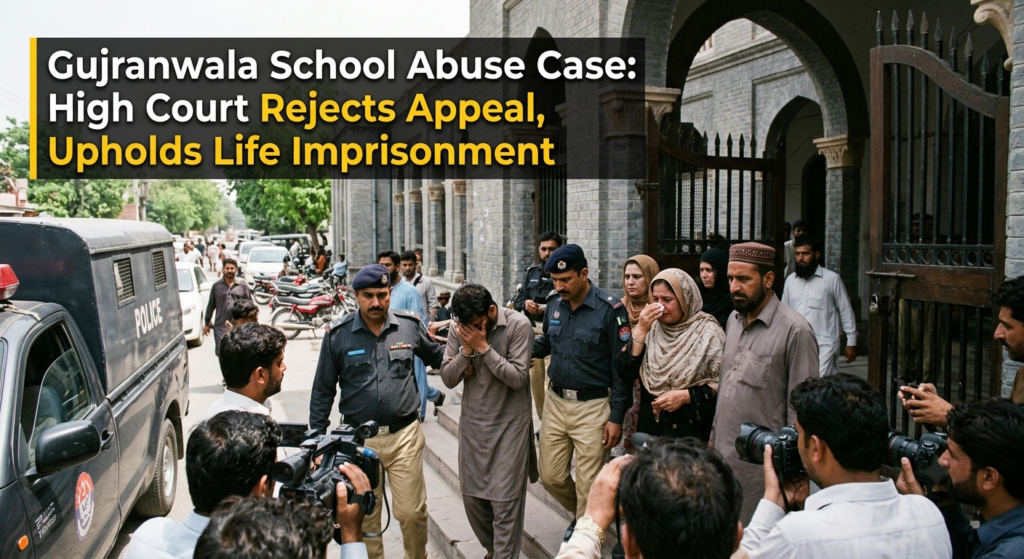
The Lahore High Court has upheld the life imprisonment sentence awarded to a school watchman convicted in the Gujranwala school abuse case, dismissing his appeal after finding that the prosecution had proved its case beyond reasonable doubt. The judgment reinforces important legal principles regarding child sexual abuse cases, including the evidentiary value of a child victim’s testimony, the role of medical evidence, and the legal treatment of delays in reporting traumatic crimes.
This article explains the background of the case, the arguments presented by both sides, the High Court’s legal reasoning, and why the judgment is significant for child protection and Pakistan’s criminal justice system.
Key Facts at a Glance
| Detail | Information |
|---|---|
| Incident Date | 12 May 2017 |
| FIR Registered | 15 May 2017 |
| Victim | Six-year-old school student |
| Trial Court Verdict | 15 April 2019 |
| Convict | School watchman Kamran |
| Sentence | Life imprisonment, fine, and compensation |
| Appeal Outcome | Dismissed by the Lahore High Court |
What Happened in the Gujranwala School Abuse Case?
According to court records, the six-year-old victim had joined a well-known school in Gujranwala approximately one month before the incident.
On 12 May 2017, during the school recess, the child sought permission from her teacher to use the restroom. According to the prosecution’s case accepted by the courts, the school watchman, Kamran, took the child into a restroom and sexually assaulted her. The child later returned to her classroom.
After returning home, she informed her mother about the incident after noticing bleeding while using the restroom. Her parents immediately took her to a hospital, where a lady doctor examined the child and advised that the matter be reported to the police.
The family registered the First Information Report (FIR) on 15 May 2017, three days after the incident. The prosecution explained that the delay resulted from the family’s trauma, shock, and consultation with medical professionals before approaching law enforcement.
Trial Court Proceedings
The case was tried before the Sessions Court, where the prosecution presented the victim, her parents, medical evidence, and other witnesses.
The accused denied the allegations and claimed that he had been falsely implicated to protect the actual offender.
After examining the evidence, the Sessions Court concluded that the prosecution had successfully established the charges. On 15 April 2019, the court convicted Kamran, sentencing him to life imprisonment along with a fine and compensation payable to the victim.
The convict subsequently challenged the decision before the Lahore High Court.
Why Did the High Court Reject the Appeal?
Before the High Court, the defense challenged both the evidence and the legal findings of the trial court.
Arguments Raised by the Defense
The defense primarily argued that:
- No eyewitness directly witnessed the incident.
- The three-day delay in registering the FIR created doubts about the prosecution’s case.
- Police did not conduct a formal identification parade.
- The forensic examination did not detect semen, allegedly weakening the prosecution’s case.
- Because of the anatomical characteristics of young children, the incident should, at most, be treated as an attempted rape rather than rape.
These arguments sought to overturn the conviction or reduce the severity of the offence.
Prosecution’s Response
The prosecution maintained that:
- The victim’s testimony was truthful, consistent, and legally sufficient to sustain a conviction.
- Medical findings independently corroborated the child’s account.
- The delay in lodging the FIR was a natural consequence of the family’s trauma.
- Parents had no plausible reason to falsely implicate an innocent person by making such allegations against their young daughter.
The prosecution urged the court to uphold the trial court’s judgment.
High Court’s Legal Reasoning
Justice Amjad Rafiq carefully examined the evidence before dismissing the appeal.
Credibility of the Child’s Testimony
The High Court observed that the six-year-old victim narrated the incident with innocence, consistency, and remarkable clarity. The court found no material contradictions in her testimony and noted that she remained steadfast throughout cross-examination.
The judgment reaffirmed that a credible victim’s statement can, by itself, be sufficient to sustain a conviction in sexual assault cases when it inspires confidence.
Delay in Registering the FIR
The court rejected the defense’s argument regarding the three-day delay.
It accepted the mother’s explanation that the family was in deep shock after learning about the assault. The High Court observed that parents dealing with such traumatic circumstances often require time before approaching the police, making the delay understandable rather than suspicious.
Immediate Disclosure to the Mother
Although the mother did not witness the incident herself, the court treated the child’s immediate disclosure after returning home as a spontaneous statement admissible under the Qanun-e-Shahadat Order (commonly referred to as the doctrine of res gestae). This strengthened the prosecution’s case by demonstrating that the child’s account was made without undue delay after discovering her injuries.
Medical Evidence
The medical examination confirmed injuries consistent with sexual assault, including damage to the child’s private parts.
The High Court emphasized that medical jurisprudence does not require complete penetration to establish the offence of rape. Even slight penetration is legally sufficient. The court also observed that medical signs of injury can remain visible several days after the incident, supporting the prosecution’s explanation despite the reporting delay.
Absence of Semen
The court rejected the argument that the absence of semen disproved rape.
Referring to medical and forensic principles, the judgment explained that ejaculation is not an essential element of the offence, and semen may be absent for several reasons. Therefore, the forensic finding did not undermine the overall evidence.
Identification Parade
The High Court further held that a formal identification parade was unnecessary because the child had already known the accused. Having attended the school for about a month, she was familiar with the watchman, eliminating the need for a separate identification procedure.
What Does the Judgment Mean?
The decision reinforces several important legal principles within Pakistan’s criminal justice system.
First, courts may rely on the credible testimony of a child victim when it is trustworthy and supported by surrounding circumstances.
Second, delays in reporting sexual offences should be assessed in light of the trauma experienced by victims and their families rather than treated as automatic grounds for doubt.
Third, medical evidence must be interpreted alongside the complete factual record. The absence of semen or certain forensic findings does not automatically negate allegations of rape.
Finally, the judgment underscores the responsibility of educational institutions to maintain safe environments for children and highlights the importance of effective child protection mechanisms.
Child Protection and Legal Accountability
Cases involving child sexual abuse demand careful investigation, timely medical examination, and victim-sensitive judicial processes.
Pakistan’s legal framework seeks to protect child victims through criminal prosecution, evidentiary safeguards, and compensation mechanisms. Courts also increasingly recognize the psychological impact of sexual offences, particularly where young children are involved.
Educational institutions likewise have a duty to implement safeguarding policies, conduct employee background checks where required, establish reporting procedures, and cooperate fully with law enforcement whenever allegations arise.
Conclusion
The Lahore High Court’s decision in the Gujranwala school abuse case reaffirms key principles governing the prosecution of child sexual abuse offences in Pakistan. By upholding the conviction and life imprisonment sentence, the court emphasized that credible victim testimony, corroborated by medical evidence and supported by the surrounding circumstances, can establish guilt beyond reasonable doubt.
The judgment also provides important legal guidance on delayed FIRs, the admissibility of spontaneous statements, medical interpretation in sexual offence cases, and the limited significance of the absence of semen in forensic reports. Beyond its legal implications, the case serves as a reminder of the continuing importance of child protection, institutional accountability, and a justice system that responds sensitively and effectively to crimes against children.
This article is general information about the law in Pakistan, not legal advice for your situation.