
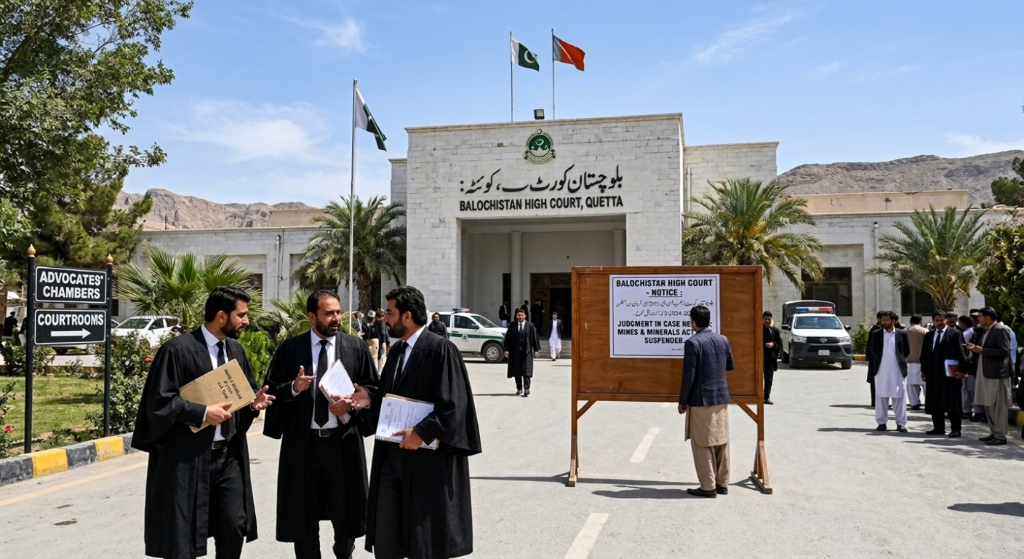
The Balochistan High Court has suspended the recently introduced Mines and Minerals Act, creating significant discussion across Pakistan’s legal and mining sectors. The decision came after several legal petitions challenged the act, raising constitutional concerns about the regulation and governance of mineral resources in the province.
Balochistan is one of Pakistan’s most resource-rich regions, with major deposits of copper, gold, coal, chromite, and other valuable minerals. Because of this, any changes to mining laws can directly affect the country’s economic development, foreign investment, and provincial governance.
According to legal insights shared by Lawyer Services Pakistan, the court’s decision highlights the importance of ensuring that mining legislation complies with constitutional requirements while also protecting investor confidence and provincial rights.
This article explains why the act was suspended, its impact on Pakistan’s mining sector, and what could happen next in the legal process.
Overview of the Mines and Minerals Act in Balochistan
The Mines and Minerals Act was introduced to modernize Balochistan’s mining regulatory framework and encourage investment in mineral exploration projects.
The legislation aimed to create a structured system for managing mineral resources and improving transparency in mining operations.
Key Objectives of the Act
The main goals of the act included:
- Establishing a clear mineral licensing system
- Improving transparency in mining permits and exploration rights
- Increasing provincial revenue from natural resources
- Encouraging foreign investment in Pakistan’s mining sector
- Strengthening regulation of mineral extraction activities
Balochistan’s mineral reserves are considered strategically important for Pakistan’s economic growth. Updated mining policies were expected to improve resource development and exploration opportunities across the province.
However, several legal and regulatory concerns emerged soon after the legislation was introduced.
Why the Balochistan High Court Suspended the Act
The High Court suspended the implementation of the act after petitions were filed challenging the law. The court decided to review the legislation before allowing it to be fully enforced.
Legal experts associated with Lawyer Services Pakistan suggest that the suspension was intended to ensure that the law complies with constitutional and administrative principles.
Constitutional Concerns
One of the key arguments raised by petitioners involved potential conflicts with constitutional provisions related to provincial authority over natural resources.
Critics argued that certain parts of the legislation may have:
- Created ambiguity regarding regulatory control
- Affected provincial rights related to resource governance
- Introduced new regulatory structures requiring further legal review
Because mineral resources are politically and economically significant, the court decided that a thorough legal examination was necessary.
Stakeholder Objections
Several stakeholders in the mining industry also expressed concerns about the legislation.
Mining companies and investors raised questions regarding:
- Licensing procedures for mineral exploration
- New compliance requirements for mining companies
- Changes in royalty and taxation structures
These issues created uncertainty among companies involved in mineral exploration and resource development projects.
Legal Petitions Filed
Multiple petitions were submitted by lawyers, industry stakeholders, and civil society groups. The petitions argued that the law should undergo further legal scrutiny before being implemented.
The court responded by temporarily suspending the act until the legal review process is completed.
Immediate Impact on the Mining Industry
The suspension of the Mines and Minerals Act may affect several aspects of Pakistan’s mining sector.
Impact on Mining Companies
Mining companies operating in Balochistan could face delays in obtaining:
- Exploration permits
- Mining licenses
- Regulatory approvals
These delays may slow down ongoing and upcoming mining projects.
Impact on Foreign Investors
Pakistan has been actively encouraging foreign investment in the mining sector, particularly in projects involving copper and gold extraction.
However, legal uncertainty often causes investors to adopt a cautious approach until regulatory frameworks become clear.
According to an analysis published by Lawyer Services Pakistan, investor confidence in mining markets strongly depends on stable and transparent legal systems.
Impact on the Local Economy
Mining activities contribute significantly to the local economy in Balochistan.
The suspension of the act may temporarily affect:
- Employment opportunities in mining regions
- Provincial government revenue from mineral extraction
- Infrastructure development linked to mining projects
Stable regulatory policies are essential for sustaining economic growth in resource-rich regions.
Political and Legal Implications
The court’s decision also highlights broader issues related to natural resource governance in Pakistan.
Policymakers, experts, and stakeholders have long debated questions about provincial autonomy, resource management, and revenue distribution in Balochistan.
The judicial review may set an important precedent for balancing:
- Economic development
- Constitutional governance
- Investor protection
- Community interests
What Happens Next After the Court Suspension
The suspension of the act is temporary while the court reviews the petitions filed against the legislation.
Several developments may occur in the coming months.
Court Hearings and Legal Review
The High Court will examine the legal arguments presented by petitioners and government representatives.
This process will determine whether the act complies with constitutional and administrative laws.
Possible Amendments to the Act
If the court identifies legal issues, the provincial government may need to amend certain provisions of the legislation.
Possible changes could involve:
- Revising licensing procedures
- Clarifying regulatory authority
- Addressing concerns raised by industry stakeholders
Government Policy Adjustments
The provincial government may also hold consultations with legal experts, mining companies, and community representatives to improve the mining policy framework.
Such consultations can help create a more transparent and investor-friendly regulatory environment.
Expert Insights from Lawyer Services Pakistan
Legal analysts from Lawyer Services Pakistan emphasize that effective mining regulations must balance economic development with legal compliance.
A well-designed mining policy should:
- Provide legal clarity for investors
- Protect provincial rights over natural resources
- Ensure environmental and community safeguards
By strengthening regulatory frameworks, Pakistan can attract responsible investment while ensuring sustainable resource management.
Frequently Asked Questions
Why did the Balochistan High Court suspend the Mines and Minerals Act?
The court suspended the act after petitions challenged its legality and raised constitutional concerns. The suspension allows the court to review whether the legislation complies with legal and administrative requirements.
How does the suspension affect mining projects?
Mining companies may experience delays in obtaining licenses and exploration permits until the court completes its legal review.
Will the Mines and Minerals Act be reinstated?
The final decision will depend on the court’s ruling. The act may be reinstated, amended, or replaced depending on the outcome of the judicial review.
What minerals are found in Balochistan?
Balochistan is rich in minerals such as copper, gold, coal, chromite, and marble, making it one of Pakistan’s most important regions for mineral exploration and mining development.
Conclusion
The Balochistan High Court’s suspension of the Mines and Minerals Act has created important legal and economic discussions about the future of mining regulation in Pakistan.
While the judicial review process may temporarily slow mining projects, it also provides an opportunity to refine legislation and ensure that resource governance policies are transparent, constitutionally compliant, and beneficial for all stakeholders.
As highlighted by Lawyer Services Pakistan, strong legal frameworks and policy stability will be essential for unlocking the full potential of Balochistan’s mineral resources while maintaining investor confidence and sustainable development.